How far can a chain of surrogates take us in biomolecular interactions?
Systems, proteins, ligand binding, drug discovery, pharmacology. Biology has a
ladder of scales, and machine learning now has one running alongside it. Two days at the
University of Auckland finding out how far up you have to climb before the answer can be
trusted.
Two steps, both free: an RSVP for Auckland, and the global event's
registration.
When
Mon 19 Oct, 10am – Tue 20 Oct, 4pm
Where
Digital Research Innovation & AI Lab · Level 10, 70 Symonds Street
Cost
Free
Bring
A laptop
The question
Physiological outcomes come from molecules interacting. Those interactions produce
functional change. Function is driven by spatial and structural change. Pharmacology is the
effect of drugs on that system.
Association models over sequence, 3D-aware models over structure, interatomic potentials over
atoms and motion, multi-scale models over cells and tissue. Most are open-weight and most
arrived recently. Most of us know our own rung.
Open Scientific Intelligence Hackathon for the Physical Sciences & Mathematics
This is the thing that got us to run a site at all.
Now in its fourth year. It began as the LLM Hackathon for Materials Science and
Chemistry and has widened to the physical sciences and mathematics — agents, language
models, datasets, benchmarks, models and scientific software. Free, hybrid, and run from
sites around the world on the same two days.
Auckland runs Mon 19 – Tue 20 October; the global days are 21–22 October. Their
registration is the one that makes a project visible to the judges, and Wednesday the 21st is
open if a group wants to carry the work across. Every edition is written up with every
contributor named, which for two days' work is a real line on a CV.
All open source, all from the 2025 event. Worth half an hour before October:
it's the fastest way to see what two days actually produces, and several of these are live
starting points rather than sketches.
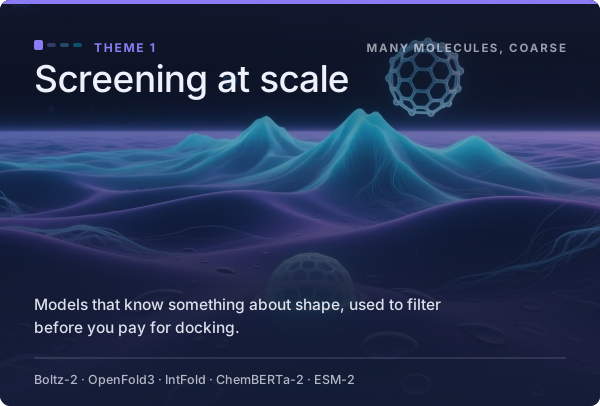
Near theme 1 · Screening at scale
MIDAS — an agentic interface for
structure-based drug design, steering DiffSBDD inside a pocket and analysing the poses it
gets back.Glasgow
SmeLLMap —
ESM-2 embeddings over receptors with voxelised binding cavities: a different answer to how
you represent a pocket.Duke
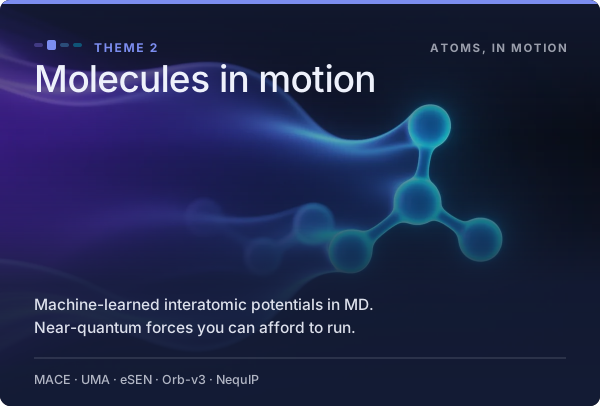
Near theme 2 · Molecules in motion
UMADock — docking with an
MLIP as the scoring function, with desolvation and ligand-strain terms.CafChem
DynaMate — autonomous
protein–ligand MD over GROMACS and AMBER with MM/PB(GB)SA, and quality checks that retry
when a step fails. Started at the hackathon as DynaAgent and still being developed.EPFL LIAC · preprint
LARA-HPC — an agent
that submits electronic-structure workflows to a cluster, with a rehearsal mode that
validates before anything real runs.CEA, CNR, INRIA, RIKEN and others
DFTPilot — retrieval plus
crystal GNNs to set up and preview a DFT calculation before you pay for it.DTU, UCL, Cambridge, NTU
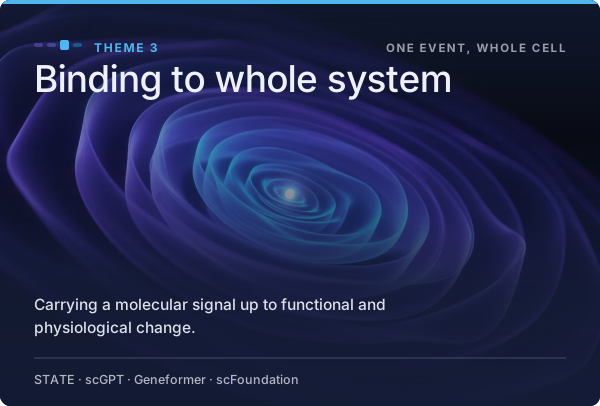
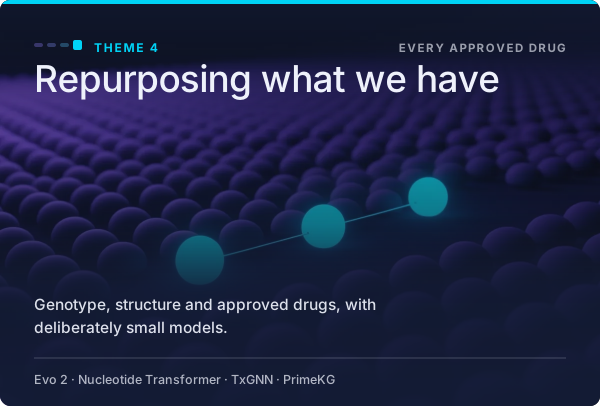
Near themes 3 and 4
Thin, which is the interesting part. Nothing in 2025 carried a molecular signal up to
cells or physiology, and nothing took on drug repurposing directly.
AssemblAI — designing peptide
self-assembly protocols, the nearest thing to working up a scale.Harms Informatics, MIT
ARIA —
causal knowledge graphs for inverse design: the machinery theme 4 would use, pointed
somewhere else.Johns Hopkins
Useful whatever you work on
ACME — literature to structured
data, end to end. Fifth overall in 2025, and the quickest route to a dataset when you
don't have one.Argonne
AtomBridge — papers to
validated structures, with physical sanity checks on the way out.UIUC, Northwestern, Chicago, Georgia Tech
ATOMS Lab — property
prediction on 50–300 examples, with the support set ablated properly. Small-data method,
done carefully.UMBC
MCP4SDL — MCP interfaces to lab
instruments.UBC, Tennessee, ETH Zürich, Empa
Themes
Four to start from. They describe the kind of work we're interested in, and they come from
where we happen to sit. Bring your problem and take a space. If none of them fit, add one —
we're making room for people to gather, and the shape of the room is still open.
And the wider scope
The global event takes submissions across the physical sciences and mathematics, in any of
these:
Anything in that scope works here. A benchmark nobody has built, a dataset that should exist,
a piece of software your field keeps rewriting, an agent that does a job you currently do by
hand — all of it counts, and none of it has to be about ligands.
The two dotted tiles are real. Propose a theme and we'll make
space for it. We also have default targets and chemistry ready if you'd rather pick something
up.
What a group does
01
Find out what open-weight models exist in your area. The
landscape moved a long way in the last eighteen months.
02
Get one or two running on our hardware. Being able to run
it is the main filter.
03
Work out what to measure, and report it back at the end of
day one.
That third one is the move we care most about. A recent benchmark found single-cell foundation
models level with a simple linear baseline at predicting perturbation effects, and another found
the choice of metric changes which model comes out on top. How to evaluate these things is
genuinely unsettled, and there's a lot of room to do useful work there.
Each group sources its own data and picks its own benchmark. Groups stay comparable by
answering the same four questions about whatever they picked:
What's your ground truth?
What are you comparing against, and is there a simple baseline in there?
What would change your mind?
Where would it break?
Who it's for
Come and explore the broader opportunity while getting hands-on with AI in your own
area.
You don't need to be able to code
Come prepared to work with AI agents and with code. The agent writes the code. You bring
the judgement about whether the answer is any good. Everyone is welcome here, whatever you
last wrote and whenever you last wrote it.
Chemists and structural biologists
Shape, pockets, poses
Physicists and computational chemists
Potentials, forces, motion
Systems biologists and pharmacologists
From a binding event to a phenotype
Statisticians and ML researchers
Evaluation, baselines, what the numbers support
Bioinformaticians and clinicians
Variants, approved drugs, repurposing
Research software engineers
Making any of it run, twice
We're inviting project teams. A group leader brings their team,
their expertise, and a problem or candidate. If you can only come for the opening, come for the
opening and leave your team to it. Coming on your own works too.
The two days
Day 1 — get running, do something, work out what to measure, report back. You can pick a
benchmark once you've seen a model behave, so that comes after the running.
Day 2 — measure it, and report what you got, including the negatives.
Bookends each day, lightning talks each day, work in ones, twos and threes, and food and a
social occasion both days. Setup is agentic support plus our team, and at least one model per
theme will be running on our hardware before you arrive.
No stupid questions. It's safe to experiment. A negative is a result.
Registering
Two steps, and both are free. The first one gets you into the room in Auckland. The second is
the global event's, and it is what makes a project visible to their judges, so a group that
means to submit needs both.
01 · AUCKLAND
RSVP for the Auckland site. Name, email, what
you work on, what you want out of the two days, and which days you're coming.
You can come for one day or both, and you can join remotely instead if getting to Symonds
Street doesn't work. The form asks which, so say so there.
Submitting
Judging is the global event's, and so is the submission. Teams submit through
the main site,
which is where the judges see it. There is nothing to hand in to us.
What that has meant, and what to plan for: a video of two minutes or less, posted
somewhere public, and one form for the team. The judges weigh potential for impact, how
innovative the approach is, whether it would scale, and how it lands in its field. Past years
also show that the write-up is what gets a project into the community paper — 32 of the 120
submissions in 2025 were left out of it for incomplete documentation.
The 2026 deadline has not been announced. It falls at the end of the global Day 2, once
our two days are over, and the organisers say it goes to Slack before it goes anywhere else.
Their submission page still carries last year's date, so take the deadline from Slack or from
their agenda.
Running on the 19th and 20th leaves that window open: our two days finish before the global
days begin, so a group has time to cut the video and write the thing up.
Questions
Open an issue in the repo, or ask in the
hackathon Slack — the invitation comes with registration.